2026 Poster Competition Winners Announced
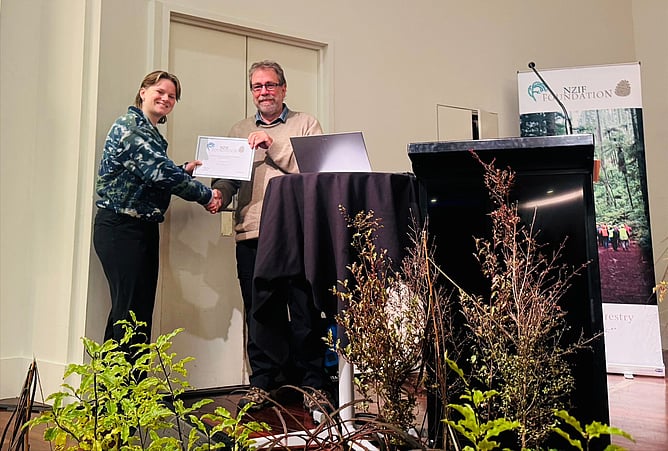
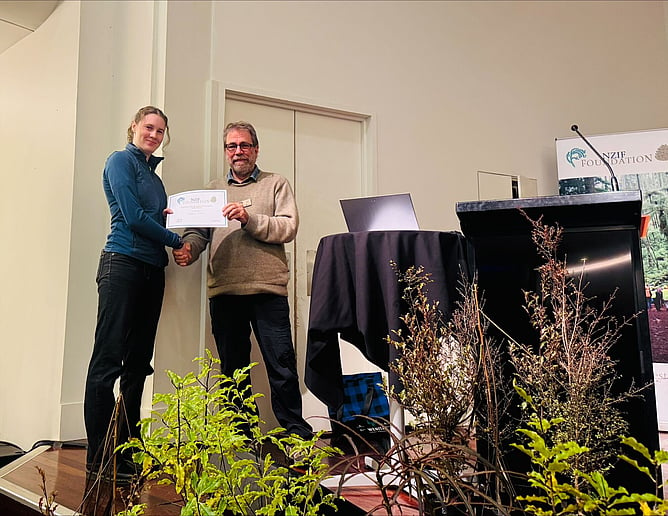
The Forest and Wood Foundation is pleased to announce the 2026 Poster Competition winners.
15 posters were presented during the New Zealand Institute of Forestry conference with conference attendees voting to determine the winner.
1st place went to Tasman Claridge for "Beyond Radiata: the case for stone pine on marginal land"
Tasmans study asks whether stone pine is financially competitive on marginal land in Marlborough given income potential from pine nuts, NZU's, timber and interim grazing over its longer rotation. His model draws on operational data from Pinoli Pine Nuts Ltd and valuation inputs from various industry sources.
2nd place went to Alice Keeling for "Rooted in Regulation: Municipal Constraints on Urban Street Planting in Christchurch"
Christchurch City Council aims to lift city-wide canopy cover from 13.5% to 20% by 2070, but tree planting on streets is constrained by buffer distances required around infrastructure like power poles, driveways, and underground pipes. This study maps these constraints across six road segments representing residential, commercial, industrial, and rural zones, then uses a sensitivity analysis to test how relaxing each buffer would change available planting area. Buffers with overlapping influence are also tested together to capture compounding effects. The results will identify which infrastructure regulations offer the greatest opportunity to expand street tree planting space, supporting evidence-based recommendations to the Council.
3rd place went to Rebecca Simcic for "The Influence of Windthrow on Felling Machine Efficiency"
Following the major storms in the Nelson/Tasman region, and the realisation that similar windthrow events have occurred elsewhere around the country, it is becoming apparent that windthrow is likely to become an increasingly frequent challenge for the forestry industry. As the industry moves forward, gaining insight into how windthrow affects harvesting operations will be valuable, and this project aims to provide that insight.
To achieve this, a time and motion study method was used. Data was collected from two different harvesting crews working in the Nelson region, with each crew observed both when working in windthrow trees and when working in standing trees. This data will be analysed to examine how windthrow affects machine productivity, how it affects the time allocation of harvest cycle elements, how it affects productive machine hours, and whether additional work elements are required when working in windthrow.